Claire Parker of Falcon Boat Club wins first adaptive final at the British Rowing Masters Championships 2026
Claire speaks to us about the adaptive rowing scene, how welcoming it is and how others can get involved in rowing and racing
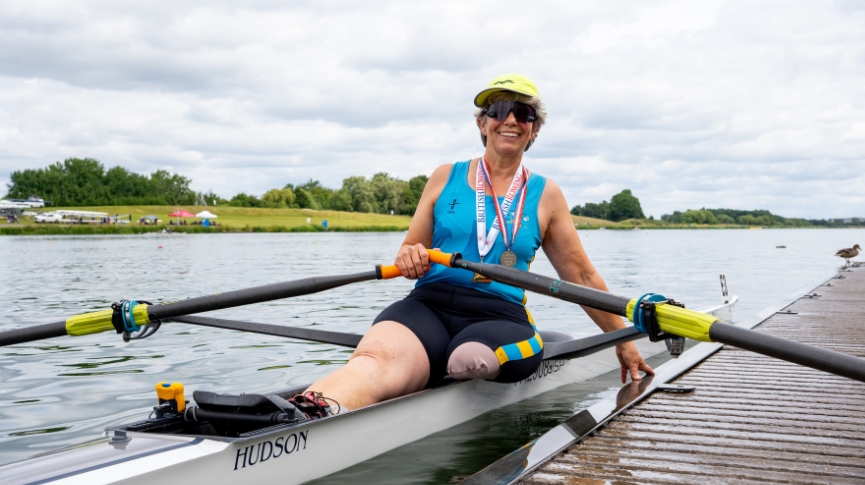
Credit: British Rowing
Great Britain’s history in Paralympic rowing precedes itself. With gold at every Games since rowing was introduced to the programme in 2008, GB has won over 50% of the gold medals awarded in Paralympic rowing.
This success is supported by a dedicated group of clubs around the country who have for many years worked hard to offer adaptive rowing to anyone who might want to try it. In recent years more and more clubs are ensuring they have the facilities to host adaptive athletes, and regattas too are trying to improve their adaptive race offerings.
There is plenty of work to be done both by us at British Rowing and by clubs and competitions to ensure that adaptive rowing continues to grow. This year was the first time that the British Rowing Masters Championships has offered adaptive categories, and five rowers raced on Sunday for medals. First across the line was Claire Parker, from Falcon Boat Club.
“I rowed at university in 1980,” Claire said. “I learned to row at and competed for Cambridge University, and then I rowed for the University of London and won silver competing here in 1984!”
Two years later, Claire was diagnosed with cancer and had her leg amputated. “I thought, that’s it. End of story. No more rowing.”
Claire went on to have a busy career as a doctor, until one of her friends asked her coach whether Claire would be able to row. “The answer was yes. So I then started rowing.”
Adaptive rowing is incredibly individualised, with adaptations made to boats and equipment according to specific disabilities. “I used another leg to get me onto the water, but I row without an artificial leg because if you capsize you can’t get out. And I have capsized a couple of times.”
Claire began rowing in an eight with her club, then started to learn to scull so she could go out in quads. Claire’s amputation means she can still use a sliding seat, classing her as AR3 (Adaptive). The GB PR3 (Paralympic) Mixed Coxed Four has been undefeated by any international crew since 2010.
Rowing has taken Claire to some incredible places. “I’ve done touring rowing around Norfolk, the lakes. I’ve done tours in France. It’s absolutely wonderful, I really enjoyed that.
“But then when I retired three years ago, I had the opportunity to buy a really nice boat from someone else in the club and I decided to give racing a bit of a go. It’s been going very well. I raced at two races at Marlow, in a single and an adaptive double.”
Claire has witnessed the increase in opportunities for adaptive racing. “I love the adaptive rowing community – they’re very, very supportive, very keen to get races up and running. So this is fabulous that we’ve got this here today at the Masters. Quite often I row against people who are 45 years younger than me, because I’m 65. So it’s quite nice that this is for Masters. I really want to encourage all the other adaptive rowers out there to come next year, because I think this is the start of something good.”
Claire won her race against Gillian Middleton from Stratford Upon Avon Boat Club, a club well known for it’s excellent adaptive rowing facilities. She finished the 1000m course in a time of 05:37.43, whilst her competition finished in 07:21.04.
“When I rowed here before, there was this massive crosswind. But this was calm, no wind; a beautiful day in Nottingham.I thought I’d do around 5:45 or 6 minutes for the 1000m, so this result is nice. It was a good race.
“Gillian, who I raced against from Stratford-on-Avon, I think she’s only done one or two races before, she did a fabulous race. She was rowing really strongly and in a straight line, which was not quite what I was doing! The more people we can get to come out and race, the better.”
Claire’s message to anyone who is interested in adaptive rowing is to give it a go!
“When I get out onto the water, regardless of where we are, I’m outside and I’m really enjoying it. There’s a natural environment and it just changes everything. When I used to work, it was a stress-free environment. The people involved in rowing are really, really nice and very supportive. It’s a great collegiate, friendly thing.
“I’m very fit now, which I don’t think I would be if I’d retired three years ago and just eaten cake – which I might have done! Now I’m very fit and I’m happy.”
How to get into adaptive rowing
If you’re interested in trying adaptive rowing, get in touch here and we’ll be able to help you!
If you’re a club who would like to support adaptive rowing, find out more on the page below.